
Buyer Persona
What Is a Buyer Persona? Definition, Elements, and How to Build One

A buyer persona is a detailed, semi-fictional profile of your ideal customer, built from real data and research. It pulls together the key demographic, psychographic, and behavioral traits of your audience into one concrete portrait you can actually work with: someone with a name, a job, a daily routine, specific frustrations, and clear motivations for buying.
Personas turn abstract market segments into people. Instead of "young professionals aged 25 to 34," you have "Sarah, a 29-year-old product manager in Brooklyn who works 50 hours a week, exercises early in the morning before standups, and pays more for things that save her time." That kind of detail is what makes marketing, sales, product, and support actually land.
Buyer Persona vs. Target Audience: What's the Difference?
hese two terms often get used interchangeably, but they describe different things.
A target audience is a broad group with shared characteristics: "fitness enthusiasts in the US," "B2B SaaS founders," "young parents." It's the size of the market you're addressing.
A buyer persona is one specific representative of a segment within that audience. A sports nutrition brand's target audience might include serious athletes, casual gym-goers, and complete beginners. Each of those gets its own persona because their motivations, language, and buying triggers are completely different.
Even within one segment, you might create multiple personas. Among beginners, for example, one persona could be motivated by recovering from a health scare, while another is driven by the goal of looking better at the beach. Same demographic on paper, completely different sales conversations.
Why Buyer Personas Matter
A good persona pays for itself across the entire business, not just in marketing.
Marketing. When you know exactly who you're talking to, your campaigns become more relevant. Personalized recommendations, the right tone, the right channel, the right offer at the right moment. All of it lifts engagement and conversion. Hyper-personalization, now powered by AI tools that mine purchase history and browsing behavior, can only work if you've already done the persona thinking underneath.
Sales. A salesperson who understands the customer's pain points and goals can frame the product in a way that resonates immediately. Personas help reps anticipate objections and use language the buyer actually uses. They also drive upsell and cross-sell. A great example is Best Buy or Amazon offering a protection plan when you buy a gaming keyboard. The persona work behind it identified a real anxiety (expensive equipment getting damaged) that the buyer hadn't even named yet.
Branding. When a brand reflects the values and lifestyle of its audience, it builds emotional loyalty. Whole Foods doesn't sell groceries; it sells an identity to a specific kind of customer who pays a premium for organic, ethically sourced food and convenient prepared meals. That positioning only works because they understand the persona deeply enough to align everything from packaging to in-store experience.
Product. Personas help product teams build the right features and avoid building wrong ones. In 2021, McDonald's India launched a special "EatQual" burger packaging designed with input from people with disabilities, allowing the burger to be eaten one-handed. That came directly from persona research: understanding a real audience need that mainstream packaging had ignored.
Customer support. Support agents who understand the underlying anxieties of a persona handle escalations better. They can recognize why a customer might be panicking, even when the surface complaint sounds minor.
Expert insight: Personas aren't just a marketing artifact. They're useful across the company. Sales teams use them to speak the customer's language. Product teams use them to prioritize the right features. Support teams use them to understand why a customer might be frustrated, angry, or scared, even when
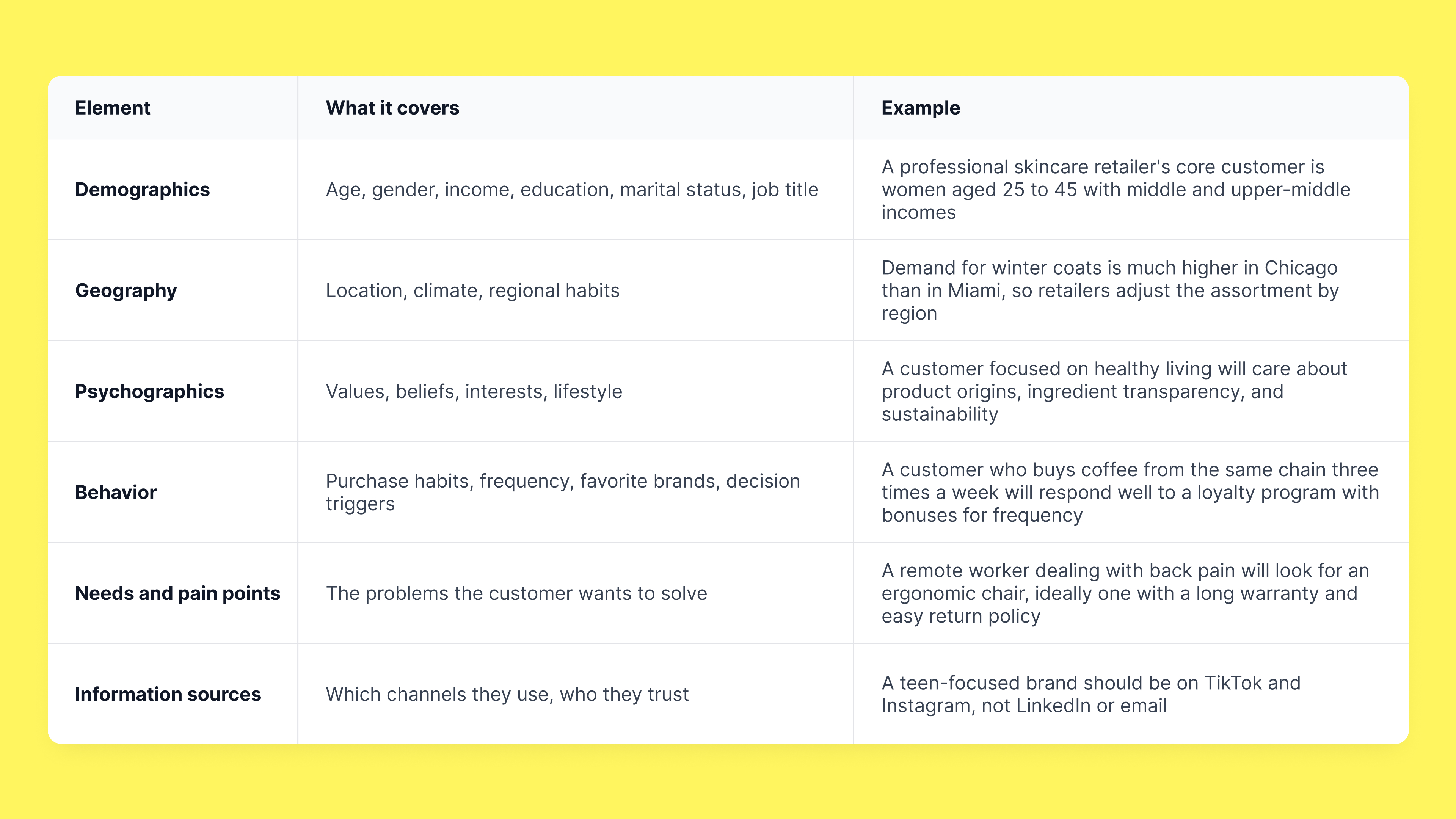
For B2B businesses, add layers like company size, industry, role in the buying committee, budget authority, and key business outcomes. Most B2B teams call this an Ideal Customer Profile (ICP), and they often build it alongside individual personas (the actual humans inside those companies).
Expert insight: Build personas from drivers and barriers, not from demographics. That's where the real targeting happens. A customer doesn't buy sports nutrition because they want to build muscle. They buy it because they're afraid of looking weak in front of other people at the gym. That psychological driver is far stronger than age, income, or even hobby data. When you build personas around those emotional truths, your value proposition starts hitting the actual nerve.
Where to Find the Data
A persona is only as good as the research behind it. Guessing produces guess-quality marketing. There are three main places to look for real insight.
Internal data
The richest source for any business that already has customers. Start with:
- Your CRM. Pull customer profiles, purchase history, average order value, and contact frequency from tools like HubSpot, Salesforce, Pipedrive, or Close.
- Web and product analytics. Tools like Google Analytics 4, Mixpanel, Amplitude, and Hotjar show which pages get visited, how long users stay, which products draw the most interest, and where they bounce.
- Sales and support team interviews. Your frontline staff talks to customers every day. They know the common objections, the recurring complaints, the language customers actually use, and the patterns nobody outside the team would notice. Get them in a room for an hour.
- Call tracking and recordings. Tools like Gong, Chorus, and CallRail capture sales conversations and surface common questions, hesitations, and triggers. Goldmine territory for personas.
Surveys and customer interviews
Sometimes the best way to understand customers is to ask them directly.
Surveys are good for breadth. Send an incentivized survey to your customer base through tools like Typeform, SurveyMonkey, or Google Forms, and you can spot patterns across hundreds or thousands of responses.
Interviews and focus groups are good for depth. A 30 to 45 minute one-on-one conversation with a real customer reveals things no survey can: how they describe the problem in their own words, what they tried before finding you, what almost stopped them from buying. Even body language and tone tell you something.
For new businesses without customers yet, both approaches still work. Talk to prospective customers in your target audience. The conversations might be slightly less specific, but they're still infinitely more useful than guessing.
External research
If internal data is limited, the wider world offers plenty of signals.
- Search behavior. Tools like Google Trends, Semrush, Ahrefs, and AnswerThePublic show what your audience is actually searching for and how their interests shift over time.
- Social listening. Platforms like Sprout Social, Brandwatch, and Brand24 track mentions, sentiment, and conversations across social media. You see what people say about your category, your competitors, and yourself when nobody's selling them anything.
- Competitor analysis. Pay attention to how competitors position themselves. If a major player keeps emphasizing one product benefit, there's a good chance their customer research showed that benefit matters most. Use that intel as a hypothesis to test, not a conclusion to copy.
- Industry reports. Sources like Statista, McKinsey, Forrester, eMarketer, and Pew Research publish ongoing data on consumer behavior, demographics, and category trends.
Where to Find the Data
A few classic mistakes ruin even well-intentioned persona work.
Building personas from demographics only. "Female, 30 to 45, suburban, middle income" tells you almost nothing about how to actually sell to someone. Personas need motivations, fears, and decision drivers.
Inventing the persona instead of researching it. A persona that comes from a brainstorm in a Zoom call is a stereotype, not a customer. Without real interviews and data, you'll build the persona of who you wish your customer was, not who they actually are.
Too many personas. Some teams build 12 personas, then never use any of them. Most businesses operate well with two to four. Start small, get it right, expand if needed.
Treating personas as static. Audiences change. Markets change. Personas built three years ago might describe customers who don't exist anymore. Revisit them annually.
Keeping personas in a slide deck nobody opens. A persona only matters when it influences real work. Print them on the wall, build them into your CRM, reference them in campaign briefs and product specs. If they don't shape day-to-day decisions, they're just decoration.
Key Takeaways
- A buyer persona is a detailed, research-backed profile of your ideal customer. It turns broad audience segments into specific people you can market and sell to effectively.
- Personas differ from target audiences. The audience is the group; the persona is one detailed individual within it. Most businesses need a few personas, one per major segment.
- Strong personas drive better outcomes across marketing, sales, branding, product, and support. They're a cross-functional asset, not just a marketing artifact.
- The best personas combine demographics and geography with psychographics, behavior, needs, pain points, and information sources. The most powerful element is usually the emotional driver behind the purchase.
- Build personas from real data: CRM, analytics, sales interviews, customer surveys and 1:1 conversations, search behavior, social listening, and competitor research.
- Avoid the classic traps: demographic-only personas, fictional ones, too many of them, outdated ones, and personas that sit in a deck nobody reads.
A good buyer persona doesn't tell you what your customer looks like on paper. It tells you what they're afraid of, what they want, and what would make them choose you over the next option. That's the version worth building.


.jpg)
.jpg)

.jpg)


Get in touch today to discuss how we can help your brand stay ahead
